

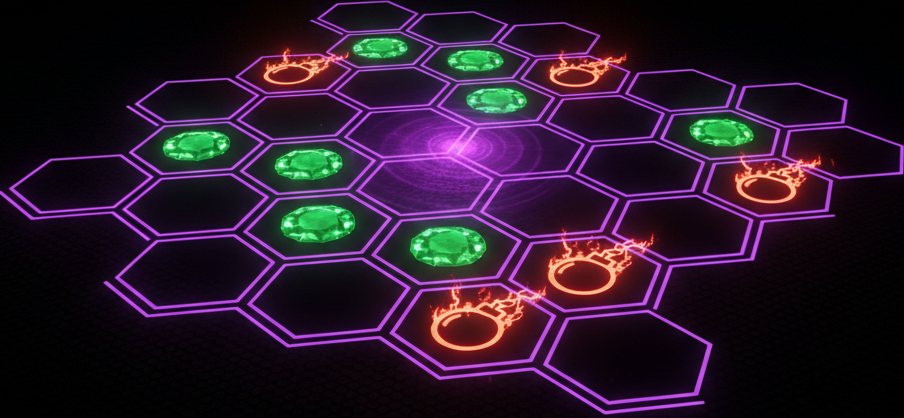
If you've played Mines for any length of time, you've probably noticed something peculiar: adding just one extra mine to the grid doesn't feel like a minor adjustment. It feels dramatically harder. Your wins become noticeably less frequent, and those seemingly safe grids suddenly betray you more often. This isn't your imagination playing tricks on you—it's mathematics in action.
The Mines game, with its deceptively simple grid-based gameplay, hides a sophisticated probability model underneath. Unlike many casino games where increasing difficulty scales linearly, Mines operates on an exponential difficulty curve. Understanding why this happens—and how dramatically your odds change with each additional mine—is crucial for anyone looking to play strategically rather than blindly clicking tiles.
Understanding the Basic Probability Framework
Before we dive into exponential scaling, let's establish the foundation. Mines typically operates on a 5×5 grid containing 25 tiles. Players choose how many mines to place on the grid (usually between 1 and 24), then reveal tiles one by one, hoping to avoid the mines while collecting increasing multipliers.
The probability of your first click being safe is straightforward:
Safe tiles ÷ Total tiles = Your odds of survival
With 1 mine on a 25-tile grid, you have a 24/25 (96%) chance of survival on your first click. With 2 mines, it drops to 23/25 (92%). Simple enough, right?
But here's where things get interesting. Your second click isn't independent of your first. Each successful reveal changes the remaining grid composition, creating a cascading probability chain that compounds with every decision you make.
Why One Mine Makes Such a Difference
Let's compare two scenarios to illustrate the exponential nature of difficulty scaling:
Scenario A: 3 mines on a 25-tile grid
Probability of revealing 5 safe tiles: 0.88 × 0.875 × 0.8696 × 0.8636 × 0.8571 = 47.6%
Scenario B: 4 mines on a 25-tile grid
Probability of revealing 5 safe tiles: 0.84 × 0.8333 × 0.8261 × 0.8182 × 0.8095 = 38.5%
Adding just one mine reduced your success probability by approximately 19% (from 47.6% to 38.5%). That's not a 1-in-25 linear reduction—it's a dramatic, exponential drop in your winning chances.
This mathematical reality explains why experienced Mines players are extremely cautious about increasing mine count. The payout might increase, but your odds deteriorate much faster than the multiplier compensates.
The Multiplication Effect of Compounding Probabilities
The exponential nature of Mines difficulty stems from probability multiplication. Each successful click is an independent event with conditional probability—the outcome depends on what came before.
When you multiply fractions less than 1, the result shrinks faster than linear subtraction would suggest:
This compounding effect means that even small reductions in per-click safety (caused by adding mines) create massive reductions in overall round survival probability.
Consider attempting to reveal 10 tiles with different mine configurations:
5 mines: Approximately 19.3% success rate
6 mines: Approximately 13.1% success rate
7 mines: Approximately 8.6% success rate
Each additional mine doesn't just subtract a fixed percentage—it multiplies against an already-shrinking probability, creating an accelerating downward curve.
If you're interested in the mathematical foundations of casino game probabilities, calculating your expected value per round in any mini game provides essential formulas that apply across different game types.
Risk Versus Reward: Does the Payout Compensate?
Casino operators aren't foolish. They understand these probability dynamics, which is why the payout multiplier increases as you add more mines. The crucial question is whether the payout increase adequately compensates for the exponentially decreasing win probability.
In most Mines implementations, the multiplier follows a formula based on:
(Total tiles - Mines) ÷ (Total tiles - Mines - Revealed + 1)
This creates increasing payouts with each successful reveal, but the house edge remains relatively constant regardless of mine configuration. What changes is variance—more mines means higher volatility, with longer losing streaks punctuated by occasional larger wins.
The mathematical reality: adding mines increases variance without necessarily improving your expected value. You're trading consistency for volatility, which suits some player preferences but doesn't actually improve your long-term position.
Practical Strategy Implications
Understanding exponential difficulty scaling should fundamentally inform your Mines strategy:
Start Conservative
New players often gravitate toward higher mine counts, attracted by larger multipliers. This is exactly backward. Lower mine counts provide better learning environments where you can develop pattern recognition and discipline without suffering devastating losing streaks.
Calculate Your Break-Even Point
For any given mine configuration, you can calculate how many tiles you need to reveal to achieve a target profit margin. With higher mine counts, this break-even point arrives later in the round, exposing you to compounded risk for longer periods.
Recognize Pattern Illusions
Human brains are pattern-seeking machines, but Mines (when properly implemented as provably fair) generates truly random distributions. That "safe corner" isn't actually safer, and previous round outcomes provide zero predictive value for future rounds. The difference between provably fair and RNG-certified mini games explains the fairness mechanisms that ensure true randomness.
Account for Emotional Scaling
Exponential difficulty doesn't just affect mathematics—it affects psychology. Higher mine counts create more frequent losses, which can trigger emotional responses like chasing losses or abandoning proven strategies. Understanding that difficulty scales exponentially helps you mentally prepare for the increased variance.
Comparative Analysis: Mines vs. Other Mini Games
Mines' exponential difficulty scaling isn't unique, but it's more pronounced than many alternatives:
Mines sits in a unique category where player agency (choosing mine count and when to cash out) combines with compounding probability to create a deeply strategic experience. This complexity explains why mini games serve as gateways to casino gaming, offering more engagement than simple coin flips while remaining more accessible than complex slot mechanics.
The Sweet Spot: Optimal Mine Configurations
While "optimal" depends on individual risk tolerance and bankroll management, mathematical analysis suggests certain configurations offer better risk-reward balance:
Low variance (3-5 mines): Provides reasonable multiplier growth without excessive failure rates. Suitable for longer sessions and smaller bankrolls.
Medium variance (6-9 mines): Balances payout potential with manageable risk. Requires larger bankroll to weather losing streaks.
High variance (10+ mines): Dramatically exponential difficulty creates slot-like volatility. Only suitable for players with substantial bankrolls and strong emotional discipline.
Most experienced players settle in the 4-7 mine range, where exponential scaling hasn't yet reached catastrophic levels but payouts remain meaningful.
Advanced Considerations: Grid Size Variations
Some Mines implementations offer different grid sizes (3×3, 5×5, 7×7, etc.). Larger grids fundamentally alter the exponential scaling equation:
On a 5×5 grid (25 tiles) with 5 mines, you have 20 safe tiles (80% of grid).
On a 7×7 grid (49 tiles) with 5 mines, you have 44 safe tiles (89.8% of grid).
The same absolute mine count creates vastly different relative danger levels, which means exponential scaling hits at different rates depending on grid size. Larger grids delay the exponential curve, offering more breathing room in early clicks but extending the danger zone over more total clicks.
Real-World Session Variance
Theoretical probabilities describe long-term expectations, but individual sessions can deviate wildly due to variance. The exponential scaling in Mines means variance increases dramatically with mine count:
This variance reality means proper bankroll management becomes exponentially more important as mine count increases. A bankroll sufficient for 3-mine games might prove woefully inadequate for 8-mine configurations, even if the theoretical RTP remains similar.
The Psychology of Exponential Difficulty
Beyond pure mathematics, exponential difficulty scaling creates distinct psychological effects:
The safety illusion: Early clicks in high-mine games often succeed, creating false confidence before the exponential curve catches up.
The sunk cost trap: Revealing multiple safe tiles creates emotional investment, making it harder to cash out even as remaining probabilities deteriorate.
The near-miss effect: High-mine games produce more dramatic near-misses (revealing many tiles before hitting a mine), which can be more psychologically engaging than simple losses but also more frustrating.
Understanding these psychological dimensions helps you recognize when emotions are overriding mathematical reality—a crucial skill for any casino game.
Conclusion: Respecting the Exponential Curve
The exponential scaling of Mines difficulty isn't a flaw—it's a feature that creates genuine strategic depth. Adding one mine doesn't create one unit of additional difficulty; it multiplies risk across every subsequent decision in the round.
Successful Mines players respect this mathematical reality. They choose mine configurations aligned with their bankroll and risk tolerance, they recognize when exponential probability has turned against them, and they resist the temptation to chase losses by increasing mine counts beyond their comfort zone.
The game rewards mathematical literacy, emotional discipline, and strategic consistency—qualities that transfer well to other casino games and gambling contexts. Whether you're playing conservatively with 3 mines or pushing boundaries with 10+, understanding how difficulty scales exponentially gives you the knowledge to make informed decisions rather than hopeful guesses.
FAQs
How much do my odds decrease when I add one mine to the grid?
The odds reduction isn't fixed—it depends on your current mine count and how many tiles you plan to reveal. However, the effect is always exponential rather than linear. For example, going from 3 to 4 mines on a 25-tile grid reduces your chance of successfully revealing 5 tiles by approximately 19%, while going from 10 to 11 mines might reduce those same odds by 30% or more. The higher your starting mine count, the more dramatic each additional mine becomes.
Is there a mine configuration that offers the best mathematical advantage?
No configuration offers a player advantage over the house—the RTP (return to player) remains relatively constant across different mine settings, typically between 97-99% depending on the operator. What changes is variance. Lower mine counts (3-5) offer lower variance with more consistent but smaller returns, while higher counts (10+) create slot-like volatility with rare big wins and frequent losses. The "best" configuration depends on your bankroll size, session goals, and risk tolerance rather than mathematical edge.
Does the exponential difficulty curve mean I should always play with fewer mines?
Not necessarily. While fewer mines provide better short-term win rates, some players prefer the higher volatility and larger potential payouts of higher mine configurations. The key is understanding what you're getting into: high-mine games require substantially larger bankrolls to weather losing streaks and stronger emotional discipline to avoid tilt. If you have the resources and temperament, high-mine play can be perfectly viable—just don't expect it to improve your expected value.
How does Mines difficulty scaling compare to other mini games?
Mines features more pronounced exponential scaling than most other mini games. Crash games offer more linear difficulty where your primary decision is when to exit, while Plinko presents fixed probabilities for each drop. Mines sits in a unique category where sequential decisions compound into exponentially changing odds, making it more strategically complex than many alternatives. This complexity is part of why Mines has become such a popular title among players who enjoy agency and decision-making in their gambling.
Can I use previous rounds to predict where mines will be in the next round?
No. In properly implemented provably fair Mines games, each round generates a completely independent random seed. Previous outcomes provide zero predictive value for future rounds. The pattern-seeking tendency of human brains often creates perceived correlations that don't actually exist. Understanding how provably fair systems work helps players recognize that true randomness often feels "streaky" or "patterned" even when it's mathematically independent.
Why do I seem to hit mines more often when I increase the mine count beyond my usual setting?
This isn't perception—it's mathematical reality. The exponential difficulty curve means that even small increases in mine count create disproportionately large increases in failure probability. If you typically play with 4 mines and suddenly switch to 7, you're not experiencing bad luck—you're encountering the mathematical certainty that your odds have deteriorated exponentially. Your strategy, bankroll, and expectations all need to adjust proportionally to the new risk level, which is why experienced players tend to settle on a narrow range of mine configurations rather than constantly changing settings.
Ready to put your Mines strategy to the test? Visit Zizobet today and experience provably fair Mines with competitive RTPs, flexible mine configurations, and transparent probability mechanics. Whether you prefer conservative low-mine strategies or high-variance thrill-seeking, Zizobet offers the tools and fairness you need to play with confidence. Join now and discover why thousands of players trust Zizobet for their mini game action!
Frequently Asked Questions
Quick answers to common questions
Before we dive into exponential scaling, let's establish the foundation. Mines typically operates on a 5×5 grid containing 25 tiles. Players choose how many mines to place on the grid (usually between 1 and 24), then reveal tiles one by one, hoping to avoid the mines while collecting increasing m...
Let's compare two scenarios to illustrate the exponential nature of difficulty scaling:
The exponential nature of Mines difficulty stems from probability multiplication. Each successful click is an independent event with conditional probability—the outcome depends on what came before.
Casino operators aren't foolish. They understand these probability dynamics, which is why the payout multiplier increases as you add more mines. The crucial question is whether the payout increase adequately compensates for the exponentially decreasing win probability.
Understanding exponential difficulty scaling should fundamentally inform your Mines strategy:
About the Author

James Hartley
SEO Content Strategist
James Hartley is a seasoned seo content strategist with over 8 years of hands-on experience in SEO content strategy and digital marketing within the online gambling and technology sectors. Specialising in data-driven analysis and audience-first storytelling, James has helped leading iGaming brands build authoritative content ecosystems that rank, convert, and retain readers.
With a deep understanding of search engine algorithms, player behaviour, and regulatory landscapes across European and international markets, James delivers well-researched articles that blend expert insight with practical advice — empowering readers to make informed decisions whether they're exploring sports betting strategies, casino game guides, or industry news.

Get 100% Welcome Bonus up to €500!
New players only. Use code ZIZO2026 at registration.
Claim Your BonusComments (2)
Great article! These tips really helped me improve my betting strategy. The Champions League analysis was spot on.
Totally agree! I made some good picks using these insights.
Very informative content. Would love to see more articles about live betting strategies!
Related Articles

Mini Game Loyalty and Rakeback Programmes – How Crypto Casinos Reward High-Volume Instant Game Players
Discover how crypto casinos reward high-volume mini game players through loyalty programmes and rakeback. Learn what bonuses you're entitled to and how to maximise rewards.
James Hartley
Mini Game Win Caps Explained – Why Casinos Limit Maximum Payouts and How It Affects Your Strategy
Why do casinos cap mini game wins? Learn how maximum payout limits work, why they exist, and how understanding win caps can dramatically improve your betting strategy.
James Hartley
How to Calculate Your Expected Value Per Round in Any Mini Game – A Simple Formula for Every Title
Learn how to calculate expected value in any mini game with our simple formula. Understand RTP, house edge, and make smarter betting decisions with mathematical precision.
James Hartley