
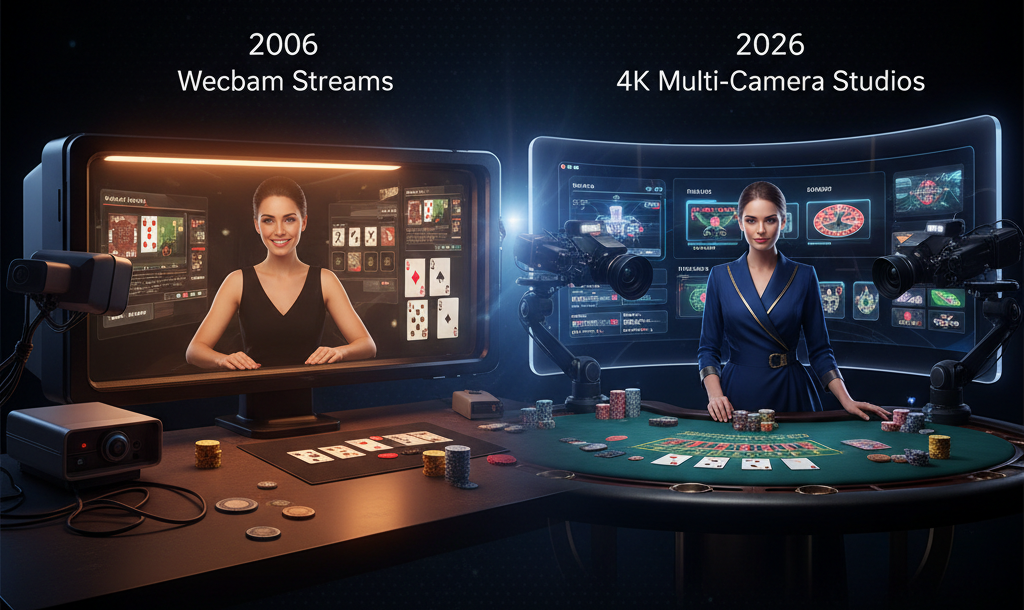

The live casino industry has undergone one of the most remarkable transformations in online gaming history. What started as a simple webcam pointed at a physical casino table has evolved into a multi-billion dollar industry featuring purpose-built studios, professional dealers, and broadcast-quality production values that rival major television networks.
If you had told someone in 2006 that live casino gaming would become the fastest-growing segment of online gambling, they probably wouldn't have believed you. Yet here we are in 2026, with live dealer games accounting for nearly 40% of total online casino revenue in many mature markets. Let's take a fascinating journey through the evolution of this incredible industry.
The Humble Beginnings: 2006-2010
The story of live casino begins in the mid-2000s when several pioneering companies attempted to merge the convenience of online gambling with the authenticity of brick-and-mortar casinos. The first live dealer games were, to put it mildly, rough around the edges.
Early providers streamed from actual land-based casinos using basic webcam technology. Picture quality was often grainy, frame rates stuttered, and audio quality left much to be desired. Players had to squint at their screens to see cards being dealt, and the experience was plagued by lag and disconnections. The technology simply wasn't ready for prime time.
Yet despite these limitations, something magical happened. Players responded enthusiastically to the human element that live dealers brought to online gambling. The social interaction, the ability to watch cards being shuffled and dealt in real-time, and the trust factor of seeing actual physical equipment rather than RNG software created a fundamentally different experience.
Evolution Gaming, founded in 2006, emerged as the company that would ultimately dominate the industry. Their early innovation focused on creating dedicated studios rather than streaming from existing casinos. This allowed for better camera angles, lighting control, and overall production quality. By 2010, they had established themselves as the premium provider, though the technology still had significant room for improvement.
The Growth Phase: 2011-2015
The early 2010s saw rapid technological advancement that transformed live casino from a novelty into a legitimate alternative to traditional online casino games. Several key developments drove this evolution:
Improved Streaming Technology
Broadband internet became more widespread and reliable, allowing providers to increase stream quality significantly. What had been choppy 240p streams evolved into smooth 480p and eventually 720p HD broadcasts. This made games actually enjoyable to watch rather than an exercise in frustration.
Mobile Optimization
The smartphone revolution changed everything. By 2012, providers realized that mobile would be crucial to live casino's future. Evolution Gaming launched its first mobile-optimized live dealer platform in 2010, but it wasn't until 2013-2014 that mobile live casino became truly viable. Portrait mode interfaces, touch-optimized betting controls, and adaptive streaming that adjusted to connection quality made live gaming accessible anywhere.
Game Variety Expansion
Blackjack and roulette dominated the early years, but providers began expanding their portfolios. Baccarat became hugely popular, particularly in Asian markets. Casino Hold'em, Three Card Poker, and other table games joined the lineup. By 2015, players had genuine variety in their live dealer options, similar to what you'd experience on a physical casino floor.
Competition also intensified during this period. Playtech launched their live casino division, NetEnt entered the market, and several smaller providers emerged. This competition drove innovation and kept prices competitive for online casinos looking to offer live dealer content.
The Innovation Era: 2016-2020
The mid-to-late 2010s represent the period when live casino truly came into its own as a distinct entertainment category. Providers stopped simply replicating land-based casino experiences and started creating content specifically designed for the online environment.
Game Show Format Revolution
Evolution Gaming's launch of Dream Catcher in 2017 marked a watershed moment. This simple money wheel game combined live dealer elements with game show aesthetics and proved wildly popular. It paved the way for increasingly elaborate game show-style offerings.
Crazy Time, launched in 2020, became the industry's biggest hit. Featuring multiple bonus rounds, augmented reality elements, and production values worthy of prime-time television, it demonstrated that live casino could be pure entertainment rather than just gambling. Players who never touched traditional table games flocked to these offerings. If you're curious about how these game shows stack up against each other, check out our detailed comparison in Crazy Time vs Monopoly Live vs Dream Catcher.
Multi-Camera Productions
Providers began implementing multiple camera angles that players could switch between. Overhead shots showed the entire table layout, close-ups captured card reveals in stunning detail, and picture-in-picture displays showed both the dealer and the game action simultaneously. The production sophistication approached broadcast television standards.
Dedicated Tables and Environments
Major online casinos began commissioning branded, exclusive tables featuring their own logos, dealers, and custom environments. VIP players could access private tables with higher limits and more personalized service. Some providers created themed environments - underwater studios, futuristic settings, and culturally-specific designs for different markets.
Lightning Game Series
Evolution's Lightning series (Lightning Roulette, Lightning Blackjack, Lightning Baccarat) added RNG elements to live dealer games, creating hybrid experiences with massive multiplier potential. This innovation bridged the gap between traditional live dealer games and slots players who craved bigger win potential.
The Maturity Phase: 2021-2023
By the early 2020s, live casino had matured into a sophisticated industry with established leaders, proven business models, and technological excellence. Several trends defined this period:
Studio Expansion
Major providers invested hundreds of millions in new studio facilities. Evolution Gaming's massive studios in Latvia, Georgia, and New Jersey featured dozens of tables running simultaneously. These purpose-built facilities included everything from climate control systems ensuring dealer comfort to acoustic treatment rivaling professional recording studios.
Regulation and Legitimacy
Live dealer gaming gained acceptance in newly-regulated markets worldwide. US states that legalized online gambling specifically included live dealer provisions. European regulators developed specific technical standards for live casino streaming. This regulatory embrace confirmed that live dealer gaming had become mainstream.
First-Person Mode Innovation
Recognizing that some players preferred RNG speed over the social element, providers introduced "First Person" versions of live games. These RNG variants could be played at high speed, with seamless transitions to the live dealer version available at the click of a button. This flexibility appealed to both game types' fans.
Chat Moderation and Community
The social aspect of live casino evolved beyond simple dealer interaction. Chat functions allowed players to communicate with each other, creating communities around popular games. Professional moderators ensured conversations remained friendly, and some dealers developed genuine fan followings, with players timing their sessions to play when favorite dealers were working.
For those wanting to master the strategic elements beyond the entertainment value, our guide on how to play live blackjack like a pro breaks down the essential techniques that serious players need to know.
The Current Landscape: 2024-2026
We're currently living through what many consider live casino's golden age. The technology has reached a point where limitations are virtually non-existent, and innovation focuses on experience enhancement rather than solving basic technical problems.
4K Ultra HD Streaming
Evolution Gaming's announcement in late 2024 that they would upgrade all flagship tables to 4K streaming by mid-2026 set a new industry standard. The difference is remarkable - you can see individual card texture details, facial expressions on dealer faces, and chip denominations with perfect clarity. Combined with HDR color processing, the visual fidelity sometimes exceeds what you'd see sitting at an actual casino table.
The implementation of 4K wasn't just about resolution. Providers upgraded entire signal chains - cameras, lighting, encoding systems, and streaming infrastructure. The result is broadcast quality that would have been impossible just five years ago. For more on how streaming quality has evolved, read about the latest developments in live casino HD streaming quality doubling with new 8K studios.
AI and Personalization
Artificial intelligence now powers sophisticated personalization systems. The platform learns your game preferences, betting patterns, and favorite dealers, then recommends tables and games accordingly. Some systems even adjust camera angles based on what you tend to focus on during gameplay.
AI also handles real-time problem detection. If the system notices unusual card distributions or equipment malfunctions, it can flag issues before they affect gameplay. This has dramatically improved game integrity and player trust.
Augmented Reality Integration
The line between physical and digital continues blurring. AR overlays add statistics, game history, and visual effects to live streams without disrupting the core experience. Some game shows now feature elaborate AR bonus rounds that transform studio spaces into fantastical environments, all while maintaining the live dealer at the center of the action.
Social Features and Gamification
Modern live casino platforms incorporate extensive gamification features including missions, achievements, and leaderboards. Players can share big wins on social media directly from the game interface. Some platforms have introduced tournament formats where players compete against each other at the same live tables.
Multi-Game Play
Technological improvements now allow players to participate in multiple live games simultaneously. You can play a hand of blackjack on one table while waiting for your roulette spin to complete on another. Picture-in-picture displays and intuitive interfaces make multi-tabling surprisingly manageable, though it certainly requires focus!
Regional Specialization
Providers now create region-specific content at scale. Dedicated studios employ native-speaking dealers for specific markets, operate during locally-preferred hours, and offer culturally relevant games. Italian-speaking dealers host games popular in Italy, while separate studios handle Swedish, Japanese, or Brazilian markets with appropriate cultural adaptations.
The Technology Behind Modern Live Casino
For those curious about what makes 2026's live casino experiences possible, the technical infrastructure is genuinely impressive:
Camera Systems
Modern studios employ broadcast-grade 4K cameras with robotic control systems. A single roulette table might have eight cameras providing different angles, all controlled by sophisticated switching systems that automatically select optimal views based on game state.
Optical Character Recognition (OCR)
OCR technology automatically reads cards, dice, and wheel results, instantly translating physical outcomes into digital data displayed on player screens. The accuracy is extraordinary - modern systems have error rates below 0.001%, with multiple verification layers ensuring absolute reliability.
Low Latency Streaming
Providers have reduced streaming delay to under one second in optimal conditions. This requires sophisticated content delivery networks, adaptive bitrate streaming, and careful optimization of every step in the signal chain. The result is an experience that feels almost instantaneous despite traveling through complex technical infrastructure.
Server Infrastructure
Major providers operate global server networks ensuring low-latency connections worldwide. Redundant systems guarantee uptime exceeding 99.9%, and automatic failover means that even if one server cluster fails, players seamlessly continue on backup systems without noticing.
Market Growth and Industry Consolidation
The live casino market has grown exponentially. Global revenue exceeded $8 billion in 2025, with projections suggesting $15 billion by 2030. This growth has attracted significant corporate interest and investment.
Evolution Gaming has solidified dominance through strategic acquisitions, purchasing NetEnt (which owned Red Tiger Gaming) and most recently acquiring Big Time Gaming and Nolimit City. This consolidation trend mirrors what's happening across the broader gaming industry, as explored in Play'n GO, Nolimit City, and Evolution - who owns what in 2026's studio consolidation era.
Smaller providers continue finding niches. Authentic Gaming specializes in streaming from actual land-based casinos, offering players the chance to bet on real casino tables from home. Ezugi focuses on emerging markets, while Pragmatic Play Live has gained significant market share through competitive pricing and solid quality.
Looking Ahead: What's Next?
As we look toward the end of this decade, several exciting developments are on the horizon:
Virtual Reality Integration
VR live casino has been "coming soon" for years, but 2026-2027 may finally deliver on the promise. Meta's latest headsets and Apple's Vision Pro platform offer compelling hardware, and several providers have confirmed VR live dealer projects. The experience of sitting at a virtual table with a real dealer and other players could represent the next major evolution.
Blockchain and Transparency
Some providers are exploring blockchain-based verification systems that allow players to independently verify game fairness. Every card shuffle, every roulette spin could be recorded on immutable ledgers, providing unprecedented transparency.
8K and Beyond
Evolution has already tested 8K streaming in limited trials. While the bandwidth requirements are substantial and adoption will be gradual, 8K live casino will likely become standard for premium tables by 2028-2029.
AI Dealers
This remains controversial, but several companies are developing AI-powered virtual dealers that look and behave remarkably human-like. Whether players will accept non-human dealers remains uncertain, but the technology is advancing rapidly.
Skill-Based Elements
Regulators in some jurisdictions now permit skill-based gambling variations. We may see live dealer games that incorporate skill elements, appealing to younger demographics who grew up with video games and want more than pure chance.
The Human Element: Why Live Casino Endures
Despite all the technological sophistication, live casino's enduring appeal comes down to something fundamentally human. In an increasingly automated world, the presence of a real person dealing cards or spinning wheels creates connection and authenticity that algorithms can't replicate.
Professional dealers have become the face of the industry. Many develop personalities and followings, with players logging in specifically to play when their favorite dealers are working. The small talk, the congratulations on wins, the sympathy on losses - these human moments create emotional engagement that pure software cannot match.
This human element also builds trust. While modern RNG systems are provably fair and thoroughly tested, some players simply feel more comfortable seeing physical cards dealt from real decks. The transparency of watching every action happen in real-time provides psychological comfort that numbers in terms of player retention and engagement.
Conclusion
From those grainy 2006 webcam streams to today's cinematic 4K productions, live casino has come an extraordinarily long way in just two decades. What started as a technical curiosity has evolved into a multi-billion dollar industry that combines cutting-edge technology with timeless human interaction.
The journey isn't over. The next five years promise virtual reality integration, even higher streaming quality, and innovations we probably haven't imagined yet. But regardless of the technological advances, the core appeal will remain - real dealers, real equipment, and real-time gameplay that bridges the gap between online convenience and casino authenticity.
As the industry continues evolving, platforms that invest in the latest technology and highest quality experiences will lead the way. Ready to experience the future of live casino gaming for yourself? Visit Zizobet today and discover why thousands of players choose our cutting-edge live dealer platform. With Evolution Gaming's complete portfolio, exclusive tables, and streaming quality that showcases every detail, you'll experience live casino at its absolute best. Join now and claim your welcome bonus to get started!
FAQs
When did live casino gaming first become available?
Live casino gaming first launched in 2006, with Evolution Gaming being one of the pioneering companies. The early versions used basic webcam technology streaming from actual casino floors or small studios, offering limited game selection primarily focused on blackjack and roulette. The quality was poor by today's standards - grainy video, low frame rates, and frequent technical issues. However, these early platforms proved the concept that players valued the human element and real-time gameplay, paving the way for the sophisticated experiences we enjoy today.
What technology improvements have had the biggest impact on live casino?
Several technological leaps transformed live casino from novelty to mainstream entertainment. High-speed broadband enabled HD and later 4K streaming, making games visually appealing rather than frustrating to watch. Mobile optimization opened the market to smartphone users, dramatically expanding the potential player base. Optical Character Recognition (OCR) technology automated result reading, eliminating errors and speeding up gameplay. Low-latency streaming reduced delay to under one second, making the experience feel immediate. Finally, multi-camera systems and professional studio environments brought broadcast-quality production values that rival television programming.
How do live casino providers ensure game fairness?
Live casino fairness relies on multiple verification layers. First, physical equipment (cards, dice, wheels) undergoes regular inspection and replacement according to strict schedules. Second, multiple high-definition cameras capture every action from different angles, with recordings stored for audit purposes. Third, regulatory bodies require regular testing and certification of all equipment and procedures. Fourth, sophisticated software monitors for statistical anomalies that might indicate problems. Finally, the transparency itself provides assurance - players watch every shuffle, deal, and spin in real-time, making manipulation virtually impossible without immediate detection.
Why are game shows like Crazy Time so popular compared to traditional table games?
Game show-style live casino games appeal to a broader audience than traditional table games for several reasons. They're visually spectacular, with augmented reality effects and elaborate set designs that create pure entertainment value beyond gambling. The gameplay is simpler and more accessible than blackjack or poker strategy, lowering the barrier to entry for casual players. Bonus rounds create excitement and massive win potential that appeals to slots players. The variety and unpredictability keep each round interesting, and the theatrical presentation makes them fun to watch even when not betting. These games successfully bridge the gap between slot players and live casino fans, creating a crossover demographic.
What internet speed do you need for modern live casino gaming?
For standard HD streaming, a minimum download speed of 5 Mbps is generally sufficient for smooth live casino gameplay. However, for optimal experience with 4K streaming, multiple tables, or while other household members use the internet, 25-50 Mbps is recommended. More important than raw speed is connection stability - a consistent 10 Mbps connection provides better experience than an inconsistent 50 Mbps connection. Most modern live casino platforms use adaptive streaming technology that automatically adjusts quality based on your connection, ensuring smooth gameplay even if bandwidth fluctuates. Mobile players on 4G/5G networks typically have sufficient speed, though data usage can be substantial with extended play sessions.
Will AI dealers replace human dealers in live casino?
While AI dealer technology is advancing rapidly and some companies are developing highly realistic virtual dealers, complete replacement of human dealers seems unlikely in the foreseeable future. The human element remains central to live casino's appeal - the personality, interaction, and authentic presence that professional dealers provide cannot be fully replicated by AI, regardless of how realistic the graphics become. More likely, we'll see AI dealers in specific contexts: off-peak hours when staffing is expensive, entry-level tables with lower limits, or specialized game variants. Premium tables and VIP experiences will almost certainly maintain human dealers, as the personal service and genuine human connection are key selling points. The industry may evolve toward a hybrid model where both options coexist, letting players choose their preferred experience.
Frequently Asked Questions
Quick answers to common questions
The story of live casino begins in the mid-2000s when several pioneering companies attempted to merge the convenience of online gambling with the authenticity of brick-and-mortar casinos. The first live dealer games were, to put it mildly, rough around the edges.
The early 2010s saw rapid technological advancement that transformed live casino from a novelty into a legitimate alternative to traditional online casino games. Several key developments drove this evolution:
The mid-to-late 2010s represent the period when live casino truly came into its own as a distinct entertainment category. Providers stopped simply replicating land-based casino experiences and started creating content specifically designed for the online environment.
By the early 2020s, live casino had matured into a sophisticated industry with established leaders, proven business models, and technological excellence. Several trends defined this period:
We're currently living through what many consider live casino's golden age. The technology has reached a point where limitations are virtually non-existent, and innovation focuses on experience enhancement rather than solving basic technical problems.
About the Author

James Hartley
SEO Content Strategist
James Hartley is a seasoned seo content strategist with over 8 years of hands-on experience in SEO content strategy and digital marketing within the online gambling and technology sectors. Specialising in data-driven analysis and audience-first storytelling, James has helped leading iGaming brands build authoritative content ecosystems that rank, convert, and retain readers.
With a deep understanding of search engine algorithms, player behaviour, and regulatory landscapes across European and international markets, James delivers well-researched articles that blend expert insight with practical advice — empowering readers to make informed decisions whether they're exploring sports betting strategies, casino game guides, or industry news.

Get 100% Welcome Bonus up to €500!
New players only. Use code ZIZO2026 at registration.
Claim Your BonusComments (2)
Great article! These tips really helped me improve my betting strategy. The Champions League analysis was spot on.
Totally agree! I made some good picks using these insights.
Very informative content. Would love to see more articles about live betting strategies!
Related Articles

The House Edge at Every Live Casino Table – A Complete Comparison From Blackjack to Game Shows
Discover the house edge at every live casino table game. Compare blackjack, roulette, baccarat, poker variants, and game shows to find the best odds in 2026.
James Hartley
Speed Roulette vs Lightning Roulette vs Double Ball Roulette – Every Modern Variant Compared
Speed Roulette, Lightning Roulette, and Double Ball Roulette compared in-depth. Learn which modern variant suits your style, bankroll, and risk appetite best.
James Hartley
Monopoly Live Deep Dive – Bonus Round Probability, Expected Value, and Why Mr Monopoly Matters
An in-depth mathematical breakdown of Monopoly Live bonus rounds, probability calculations, expected value analysis, and strategic insights into Evolution Gaming's iconic wheel game.
James Hartley